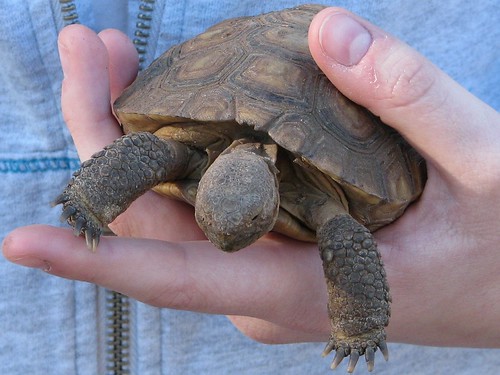
 Box turtles and snappers are a common sight here in VA, but these desert tortoises (Gopherus agassizii) are more rare and are protected in Arizona (my sister Carrie, not Erin's mom, that would be Kelley--anyway, Carrie has a mated pair and finds homes every year for the babies). So it was a bit of a surprise when this little one just wandered into Kelley's yard. This is probably a female, though she's young and it's easier to tell when there's a male and a female together--but females have more dainty horns (what we'd see as a nose) and their shells are rounder. She'll get to be about a foot long and maybe 6 inches high, and if she survives predators and real estate development, she'll outlive most humans. Erin has made her a pen and feeds her gourmet meals:
 We're not supposed to take these tortoises directly from the wild (there's an official adoption procedure), but this one is actually safer in controlled surroundings. Kelley lives in foothills, in a formerly remote area that is now being heavily developed--the combination of the human threat and the threat posed by natural predators whose terrain is being drastically reduced makes Erin's pen a safe haven: plenty of water, plenty of food, plenty of room to burrow. So don't tell.
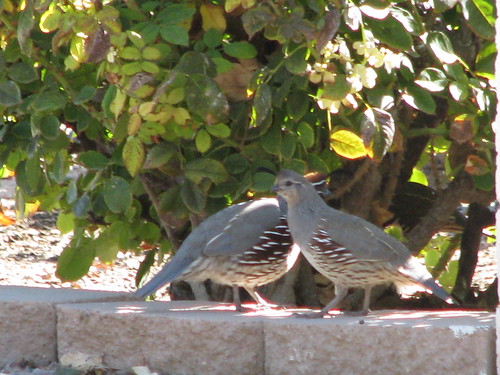
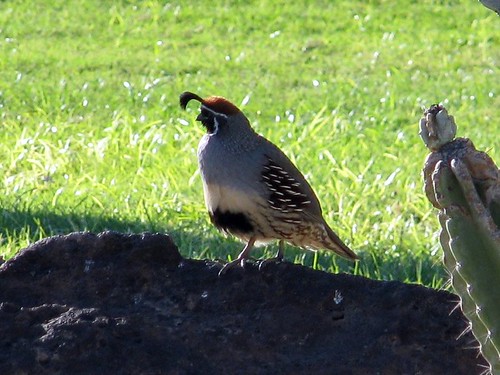
I want to say "here's a couple," but all I really know is that it's a male and a female--you can tell the male by the more intense coloration, including the black face, the little rust "helmet," and the topknot (I have these vague memories from childhood of a cartoon quail who kept blowing the topknot up out of its face--not too inaccurate as far as I can tell).
And here's a male close-up, posing on a boulder near a Cereus cactus:
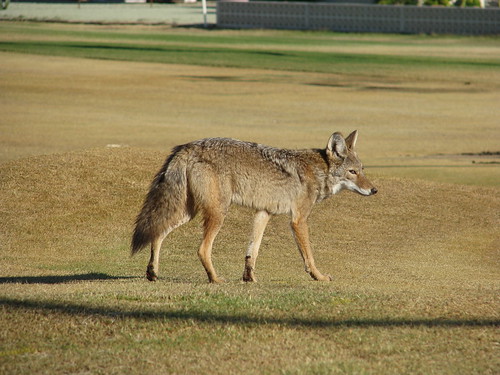
My mom's backyard extends onto a golf course, and the other course mascot is one of the quail's natural enemies, the coyote.
Despite the cartoon, I have to say that given the choice between a roadrunner and a coyote, I'll take the coyote any day. I SO wish I could have captured a picture of a roadrunner, but sightings are rare (and often brutal--they show up when they're chasing prey) and ephemeral. But they are aggressive and, IMHO and oxymoronically, pretty ugly--the one "truth" of the Warner Brothers cartoon is that the roadrunner is in fact more ruthless than the coyote (I think of them as really fast buzzards after live prey).
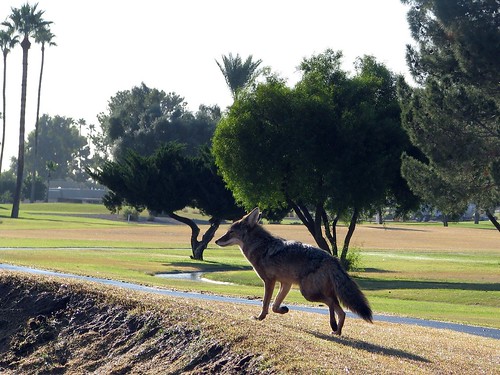
On the other hand, I have an affection for coyotes (a dog lover to the core). I don't underestimate the potential danger--they pose the same threat as any wild or strange dog does. On the other hand, they've been weirdly domesticated on Sun City courses--sometimes you have to golf over them, and they're not perturbed by humans or golf bags or carts or flying balls. And so they're easy to capture on film. Here's one (could we say, posing?) on the course just outside a neighbor's yard:
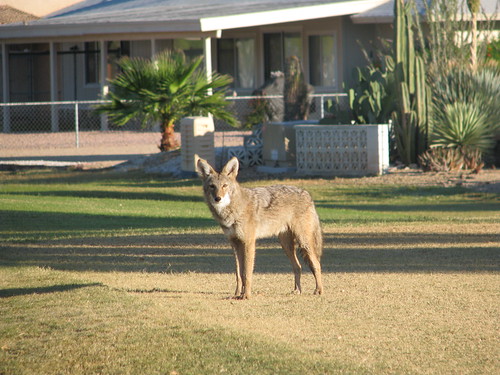
Arizona is lovely in October--it can hit 90, but as they say, it's a dry heat (which is true at 90--Arizona's low humidity 90 is pleasantly warm, as opposed to Virginia's 90, where the humidity renders the heat index in the 100's--however, at 120, it's another story--do you want some broth around you as you braise or do you prefer to be dry roasted?) Still, the coyotes seemed to relish the sprinklers:



.JPG)


